The average marketer spends nearly 13 hours a week on tasks that could theoretically run without them: building workflows, segmenting lists, writing follow-up sequences, checking campaign performance, adjusting send times. That is roughly a third of a full-time workweek spent executing, rather than thinking.
Marketing automation was supposed to solve this. And it did, partially. Scheduling emails, triggering sequences on form fills, routing leads through a pipeline: these became standard. But the model still required constant human input: someone had to build every workflow from scratch, manually check what was working, and decide what to adjust. The automation ran, but the strategy still lived in a person's head.
Autonomous marketing is a different category of approach. Rather than executing instructions you pre-define, AI agents actively imagine, build, and optimize your marketing programs on your behalf. The distinction matters a great deal for how you should think about your marketing stack in 2026.
What autonomous marketing actually means
Autonomous marketing is a fully AI-driven approach where AI agents proactively manage strategy, content creation, execution, and optimization, without requiring manual setup for each step. Unlike traditional automation that requires you to define every trigger and action in advance, autonomous marketing uses AI that learns from your data, acts on your goals, and improves with each campaign cycle.
Think of traditional marketing automation as a sports car with no GPS. It moves fast, but only in whatever direction you point it. Autonomous marketing adds the navigation: you name the destination, and the system figures out the route, adjusting in real time as conditions change.
The practical difference is significant. In a traditional automation setup, your response to a lead downloading an ebook looks like this: they enter a five-email nurture sequence, every lead gets the same emails in the same order, and sales gets notified when someone clicks a link. In an autonomous marketing setup, the system enriches that lead's data immediately, calculates a predictive win probability score, routes high-probability leads to sales via Slack before they ever complete the sequence, sends a personalized email referencing the specific pages they browsed, and simultaneously adds them to a retargeting audience on LinkedIn. Every step is adaptive based on the actual lead, not a pre-built path.
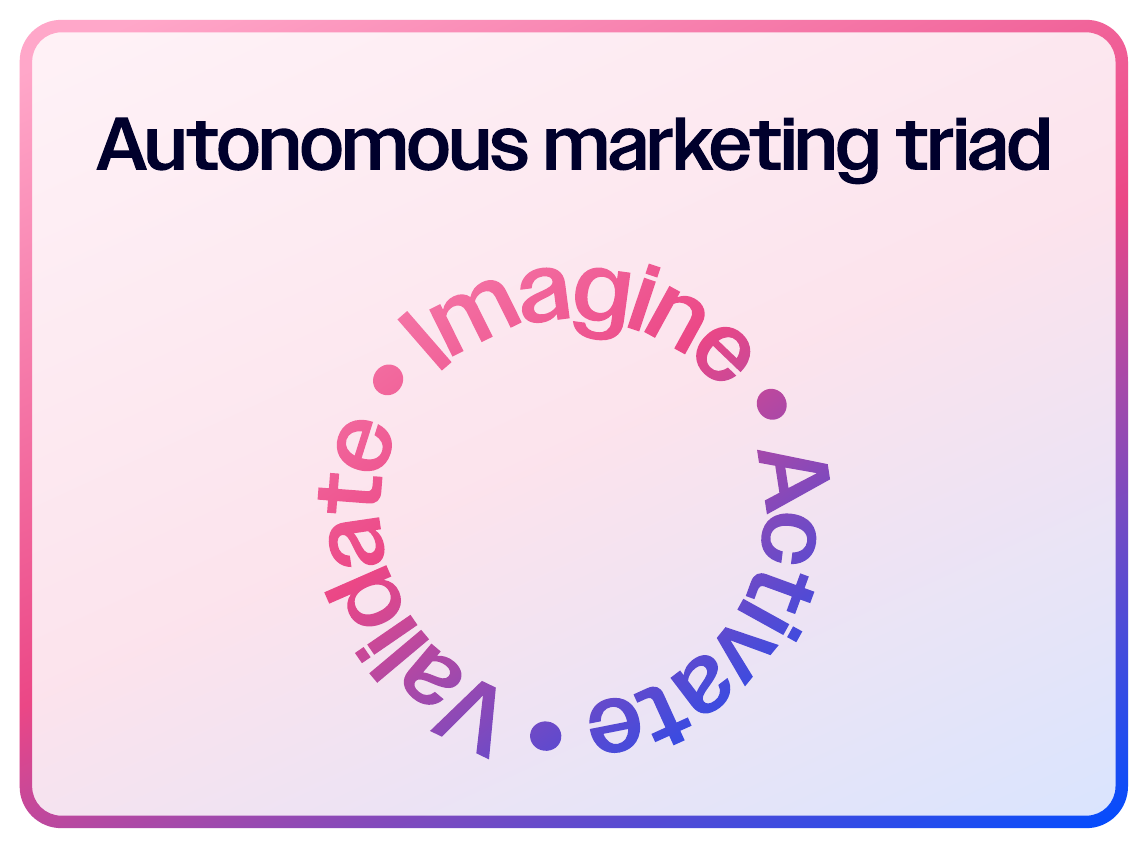
The three phases: Imagine, Activate, Validate
ActiveCampaign's framework for autonomous marketing organizes AI-powered work into three repeating phases. Most marketers today only use AI for one of the three, typically content creation, which falls under the Activate phase. Embracing all three is where the real difference in output shows up.
Imagine
Strategy and ideation. Setting business goals, identifying audiences, and planning campaigns. AI analyzes your data to surface opportunities and build the approach.
Activate
Execution. Turning strategy into live campaigns, automations, and content across email, SMS, and other channels. Generated and launched by AI from a plain-language description.
Validate
Measurement and optimization. Reviewing results, identifying what worked, and feeding those learnings back into the next cycle. No manual reporting required.
The key insight is that the Triad is a loop, not a funnel. Once the Validate phase feeds its learnings back into the next Imagine phase, the system improves continuously. It can eventually run with minimal human intervention on the execution layer, freeing marketers to focus on the strategic and creative work that still benefits most from human judgment.
How this differs from what most tools call "AI features"
Nearly every marketing platform added AI features in 2024 and 2025. Subject line suggestions, content rewriting, basic send-time recommendations. These are useful additions. They are not autonomous marketing.
The distinction is whether the AI operates on isolated tasks or across your entire marketing system. A subject line generator helps you write one email better. Active Intelligence, ActiveCampaign's AI layer, can analyze your contact data to surface a high-value segment you had not thought to create, generate a multi-step campaign targeting that segment with copy and timing optimized for each individual contact, monitor performance in real time, and recommend the next action based on results. That is an entirely different scope of operation.
A useful way to evaluate any tool's AI capability is to ask: does the AI help my marketing improve on its own, allowing me to focus on more strategic work? And does it cover all three phases of the Triad, not just content generation, but strategy and validation as well? Most tools with "AI features" answer yes to the first question only in a narrow sense, and no to the second.

Marketing automation vs. autonomous marketing: the key differences
| Marketing automation | Autonomous marketing |
|---|---|
| Single-channel, deterministic if/then logic | Cross-channel, multi-path probabilistic logic |
| You build every workflow manually | Describe your goal; AI builds the workflow |
| Reactive: responds only to triggers you've defined | Proactive: surfaces problems and opportunities before you ask |
| Bottlenecked by required human intervention at each step | Optional human oversight; system runs and optimizes independently |
| Aware of a single data stream at a time | Aware of multiple contexts and data streams simultaneously |
| Manual process adjustments after reporting | Automatic process adjustments based on campaign response |
ActiveCampaign and Active Intelligence
ActiveCampaign positions itself as the first autonomous marketing platform, and its AI layer, Active Intelligence, is the engine that makes that claim concrete. Active Intelligence is not a set of standalone AI tools bolted onto an existing platform. It runs through every part of the product, connecting the Imagine, Activate, and Validate phases into a single system that learns from your data over time.
In the Imagine phase, Active Intelligence analyzes your contacts and business goals to surface segments and strategies you may not have considered. Set a goal in plain language ("increase first-time purchases" or "reduce churn in my most engaged segment") and the platform builds campaigns, automations, and recommended next steps oriented around that outcome. It flags when you are falling behind on a goal before you have had a chance to notice.
In the Activate phase, the AI Campaign Builder generates complete campaign structures (emails, subject lines, timing sequences) from a single prompt. The AI Automation Builder translates a plain-language description of a workflow into a working automation, bypassing the manual drag-and-drop construction that makes complex automations time-consuming to build. Predictive Sending optimizes delivery time at the individual contact level, not just by list-wide best guess.
In the Validate phase, Active Intelligence pulls real-time performance data and generates concrete recommendations: warm a dormant segment, cancel an underperforming creative, shift budget toward a higher-converting path. The system considers what you have learned and recommends where to go next, closing the loop back into the Imagine phase.

The AI agents inside ActiveCampaign
Active Intelligence surfaces through a set of specific AI agents, each handling a distinct part of the autonomous marketing process.
-
AI Campaign BuilderGenerate a complete email campaign (copy, structure, subject lines) from a brief description of your goal and audience.
-
AI Automation BuilderDescribe a workflow in plain language and the platform builds a working automation. No visual editor required for the initial build.
-
Predictive SendingOptimizes email delivery time per individual contact based on their historical engagement patterns. Average result: 17% higher click-through rates.
-
AI-Suggested SegmentsSurfaces high-value audience groups (repeat buyers, at-risk customers, high spenders) that your data supports but you may not have thought to create.
-
Business GoalsTrack your campaigns and automations against specific business outcomes. AI monitors progress, flags problems early, and recommends next actions.
-
AI Brand KitImport your brand identity from your website URL in seconds. Logos, colors, and tone applied automatically to campaigns and templates.
Real results from autonomous marketing in practice
The value of autonomous marketing is most visible in how it compounds over time. Each campaign cycle feeds data back into the system, which means the platform gets better at serving your specific audience as it learns more about them. Businesses that have made the shift from traditional automation to autonomous marketing consistently report results that reflect this compounding effect.
"66% of revenue year on year is likely driven by ActiveCampaign automation. It became almost impossible to manage communication and growth manually. That is when we realized we needed automation."
Manab Boruah, Product Marketing Manager, Kommunicate. Results: 1.5x conversion increase, 24% open rates"Before ActiveCampaign, we were converting less than 10%. ActiveCampaign has doubled our conversion rate. We're now converting at over 20%."
Nathan Monk, Co-Founder, Motrain"It used to take me a whole week to create and send one campaign. Now I can create three emails in a week, and it only takes a day."
Amy Chinitz, Founder, Spark Joy New YorkThe time-savings component matters as much as the conversion gains. The autonomous marketing model returns strategic capacity to marketing teams. What previously required a week of work compresses into a day. What required a developer to implement can now be described in a sentence and built by the platform.
What kind of marketer benefits most
Autonomous marketing is not equally relevant to every situation. If you send a monthly newsletter to a small list and your program is genuinely simple, the overhead of learning a more capable platform may not be worth the gain. The value scales with complexity: the more channels you run, the more segments you manage, the faster your audience grows, and the more important it becomes that your platform can handle the execution layer without constant manual input.
Small business owners and solopreneurs gain enterprise-level campaign sophistication without needing to hire a team to manage it. Marketing teams at growing companies shift their time from building and monitoring to strategy and creative. Agencies running programs for multiple clients can scale the execution layer without scaling headcount proportionally. Ecommerce businesses with large contact lists can personalize at the individual level without manually segmenting by hand.
In each case, the central shift is the same: from being the person who builds and monitors every campaign to being the person who sets goals and reviews results, with the platform handling the work in between.
How to evaluate whether a platform is truly autonomous
Before choosing a platform on the basis of autonomous marketing claims, it helps to have a framework for evaluating what "autonomous" actually means in a given product. ActiveCampaign's own guide to evaluating autonomous marketing tools suggests thinking along two axes: AI complexity and Triad coverage.
On AI complexity, look for platforms where the AI operates at the level of self-improving performance intelligence (continuous learning without human intervention, goal-aware optimization based on business outcomes) rather than just a conversational strategy interface that draws on previous prompts. Many tools with "AI features" sit at the lower end of this spectrum.
On Triad coverage, ask whether the platform covers Imagine, Activate, and Validate for the specific tasks you need it to handle, not just one or two of the three. A platform that generates great campaign copy but cannot surface strategic insights or close the feedback loop from results back into recommendations is covering only part of the loop.
The bottom line
Marketing automation gave marketers speed. Autonomous marketing gives them leverage. The shift is not about AI replacing marketing judgment. It is about AI handling the execution layer so that human judgment can focus where it has the most impact: on the goals, the creative direction, and the strategic decisions that no algorithm can make on your behalf.
ActiveCampaign is the platform that has built most directly toward this model. Active Intelligence runs through the full Imagine, Activate, Validate loop, not just the content generation step that most platforms have bolted on. For businesses running any kind of complex marketing program, the question is less whether autonomous marketing is worth pursuing and more which platform is ready to support it.